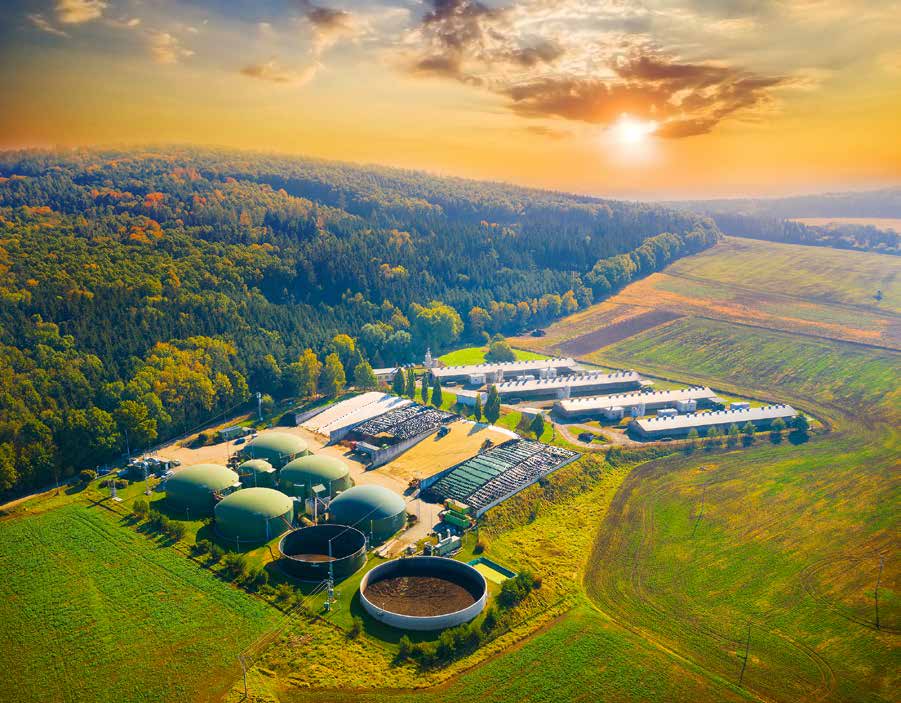
Solution
Anaerobic Digestion & Biogas
Digestion runs in four biological stages, and one of them is setting the pace of your whole plant. The MICROBE-LIFT® BGE range targets each stage separately, so a programme is built around the bottleneck you actually have.
For Farm AD units, food waste and mixed feedstock digesters, industrial and municipal AD, and biomethane upgrading operations across Ireland and the UK.
The challenge
Why a digester underperforms
Very few plants are limited by the thing operators are asked to buy for. Fibrous feedstock stalls at hydrolysis and the gas never appears, no matter how much the loading is pushed. Acids build faster than the methanogens can convert them, FOS/TAC climbs, and the plant spends the week being nursed rather than run. Solids and foam quietly steal reactor volume until a clean-out shutdown becomes unavoidable. Hydrogen sulphide corrodes the CHP engine and the upgrading train, turning a gas quality problem into a maintenance bill. Every one of those is a different stage of the same process, and a single general-purpose additive treats none of them specifically.
Our approach
How Eco Balance solves it.
The BGE (Biogas Enhancer) range from Ecological Laboratories, Inc. is four consortia, each matched to one stage of digestion. BGE₁ accelerates hydrolysis, where fibrous and high-solids feedstocks stall. BGEₕ adds cellulase and hemicellulase where the feedstock is lignocellulosic. BGE₂ is the humic and bacterial formulation that stabilises the acid stages, helping prevent VFA accumulation and foaming. BGEₘ is a targeted consortium of acetoclastic and hydrogenotrophic methanogenic archaea for the final, rate-limiting stage — and it is the product that won the World Biogas award. We start by working out which stage is limiting your plant, check your operating window against the manufacturer’s laboratory guideline, and only then build a dosing programme. Eco Balance Ltd is sole distributor for the UK and Ireland.
- Biogas output: typically a 10–15% uplift, and up to 25% in selected applications — dependent on feedstock, operating conditions and existing plant performance
- Methane concentration: 3–7% increase under optimised operating conditions
- Reactor capacity: up to 10% recovered where solids and foaming are brought under control
- H₂S: up to 50% reduction in control input costs, protecting CHP engines, compressors and upgrading equipment
- Steadier FOS/TAC and fewer VFA excursions — less firefighting week to week
- Results typically visible within 30–90 days, depending on hydraulic retention time, feedstock and digester conditions
- Improved digestate for land application once the gas has been sold
Context · evidence & policy
- BGE M — An Advanced Methanogenic Technology took Research and Innovation Project of the Year at the World Biogas Research Technology Awards 2026. The award entry names Ecological Laboratories, Inc. as developer and Eco Balance Ltd as UK and Ireland distributor.
- Published field data, high-load food processing digester on BGE₁ and BGE₂: COD down 87%, from 6,655 to 845 mg/L, and TSS down 88%, from 1,600 to 200 mg/L.
- Published field data, unstable mixed farm and food waste digester: H₂S down 97%, from around 1,231 ppm to 31 ppm, methane concentration up from 58% to 68.6%, and foam and solids build-up eliminated.
- Ecological Laboratories has been solving environmental problems biologically since 1976, with more than 40 years of documented bioaugmentation field applications.
- We publish the operating window as well as the claims. If your digester is running below pH 6.5 or above 8.0, methanogens are inhibited whatever you dose, and we will tell you that before you buy anything.
Recommended products
What we'd typically use on a site like yours.
Frequently asked
Common questions about anaerobic digestion & biogas.
- How does MICROBE-LIFT BGE actually increase biogas output?
- It does not act on the gas directly. Anaerobic digestion runs in four stages — hydrolysis, acidogenesis, acetogenesis and methanogenesis — and the slowest stage sets the pace of the whole plant. Each BGE product supplies biology targeted at one of those stages, so the limiting step is relieved. On fibrous feedstocks that is usually hydrolysis; where acids are accumulating it is stability; where gas quality is the problem it is the methanogenic stage.
- How much more gas will I get?
- Typical field improvements are 10–15%, with up to 25% reported in selected applications. It depends on your feedstock, your operating conditions and how your plant is performing to begin with. We will not quote you a guaranteed figure — Ecological Laboratories’ own application manual is blunt that anyone claiming to predict the exact outcome of a biological programme is not telling the truth.
- How quickly will I see a change?
- Typically within 30 to 90 days, depending on hydraulic retention time, feedstock and digester conditions. A plant with a long retention time will take longer to show a response simply because the material inside it turns over more slowly.
- What conditions does my digester need to be in for this to work?
- The manufacturer’s laboratory guideline puts the optimal window at pH 6.8–7.6, alkalinity 2,000–5,000 ppm, temperature 35–40°C and a FOS/TAC ratio of 0.3–0.4. Below pH 6.5 or above 8.0, methanogens are inhibited regardless of what you dose. If your plant is outside the window, fixing the conditions comes first — the biology optimises a working process, it does not rescue a broken one.
- Will it fix foaming and solids build-up?
- It addresses the biological causes. BGE₂ helps prevent the VFA accumulation and process imbalance that drive foaming, and BGEₕ improves breakdown of the fibrous material that accumulates as solids in high-TS systems. Published field data records foam and solids build-up eliminated on a mixed feedstock digester and up to 10% of reactor capacity recovered. What it will not do is compensate for undersized mixing or a mechanical fault.
- Does it reduce hydrogen sulphide?
- Indirectly, and it is worth being precise about why. BGE is not a sulphide scavenger. More complete substrate conversion leaves less material available to the sulphate-reducing pathway, so less H₂S is formed in the first place. Published field data records a 97% reduction on one mixed feedstock plant, and up to 50% savings on H₂S control input costs.
- How is it dosed into a sealed digester?
- At the inlet, with the feedstock — the vessel itself never needs to be opened. BGE₁ and BGE₂ are dosed 50:50 at 10 ppm/day against throughput, BGEₘ at 1.4 ppm/day, and BGEₕ at 4.2 ppm/day. We convert those rates into a schedule for your actual intake and supply volumes.
- Is there independent recognition of the technology?
- Yes. BGE M won Research and Innovation Project of the Year at the World Biogas Research Technology Awards 2026, as an advanced methanogenic formulation using both acetoclastic and hydrogenotrophic pathways. Eco Balance Ltd is named in the award entry as the UK and Ireland distributor.
Want a site assessment?
We'll come and look. We'll measure. Then we'll tell you what's possible.